ChromeOS impact of Infineon TPM problem

More on: https://firmwaresecurity.com/2017/10/10/infineon-tpms-generating-weak-keys/

https://twitter.com/laurenweinstein/status/917906158324662272

“You can check the TPM firmware running on your device by looking at the firmware_version line of the tpm_version entry in chrome://system. If the tpm_version entry is absent, this is likely because you are running an old Chrome OS version which doesn’t report this information. Upgrade to a newer version and check again.”

https://sites.google.com/a/chromium.org/dev/chromium-os/tpm_firmware_update


UEFI security presentation at Seattle DC206 Meeting

If you missed the Intel presentation from BlackHat Briefings this summer, and if you are in the Seattle area this Sunday, Vincent Zimmer of Intel will be reprising this presentation at the DC206 Meeting at the Black Lodge Research hackerspace.

https://www.dc206.org/?p=216

What: Oct DC206 Meeting: Firmware is the New Black
When: October 15th, 1-3pm
Who: Vincent Zimmer
Where: Black Lodge Research

Firmware is the New Black – Analyzing Past Three Years of BIOS/UEFI Security Vulnerabilities

In recent years, we witnessed the rise of firmware-related vulnerabilities, likely a direct result of increasing adoption of exploit mitigations in major/widespread operating systems – including for mobile phones. Pairing that with the recent (and not so recent) leaks of government offensive capabilities abusing supply chains and using physical possession to persist on compromised systems, it is clear that firmware is the new black in security. This research looks into BIOS/UEFI platform firmware, trying to help making sense of the threat. We present a threat model, discuss new mitigations that could have prevented the issues and offer a categorization of bug classes that hopefully will help focusing investments in protecting systems (and finding new vulnerabilities). Our data set comprises of 90+ security vulnerabilities handled by Intel Product Security Incident Response Team (PSIRT) in the past 3 years and the analysis was manually performed, using white-box and counting with feedback from various BIOS developers within the company (and security researchers externally that reported some of the issues – most of the issues were found by internal teams, but PSIRT is involved since they were found to also affect released products).

https://www.blackhat.com/us-17/briefings.html#firmware-is-the-new-black-analyzing-past-three-years-of-bios-uefi-security-vulnerabilities
http://vzimmer.blogspot.com/2017/08/black-hat-usa-2017-firmware-is-new-black.html

Click to access BlackHat2017-BlackBIOS-v0.13-Published.pdf

https://blacklodgeresearch.org/

https://www.facebook.com/events/1611758852222280/

UEFI slides from SOURCE Seattle uploaded

Last week I gave a presentation at SOURCE Seattle Conference, on defensive UEFI tools/guidance, mostly talking about NIST 147’s lifecycle, and how to use tools like (CHIPSEC, acpidump, FWTS) to look for signs of firmware attacks.

As I understand it, SOURCE Conference will have video of this presentation online sometime in the near future.

https://www.sourceconference.com/copy-of-seattle-2016-agenda-details

Slides have been uploaded to this blog, and are available here:.srcsea17. (PreOS Security will have an archive of all of our post-conference materials on Github shortly.)

At the conference, Bryan of the Brakeing Security podcast interviewed PreOS Security co-founder Paul English and myself, along with some other SOURCE Seattle speakers. I am not sure when that podcast is queued up for. I hate public speaking in general, but I cringe at completely unprepared interviews like this podcast. Sorry I didn’t have better concise answers to the questions put to me. I think the normal podcast drinking game is to drink whenever you hear ‘um’ or ‘I mean’. Be careful if you’re playing that game during my brief audio clips. 😦

http://www.brakeingsecurity.com/

http://brakeingsecurity.com/rss

@bryanbrake


A slide in the presentation pre-announces an upcoming tool we’re working on. That tool should be ready in a few weeks, more details soon.

Infineon TPMs generating weak keys?

https://www.infineon.com/cms/en/product/promopages/tpm-update/?redirId=59160

https://eesage.com/pages/103061850-tpm-update

ADV170012 | Vulnerability in TPM could allow Security Feature Bypass – A security vulnerability exists in certain Trusted Platform Module (TPM) chipsets. The vulnerability weakens key strength. It is important to note that this is a firmware vulnerability, and not a vulnerability in the operating system or a specific application. After you have installed software and/or firmware updates, you will need to re-enroll in any security services you are running to remediate those services.

Nice, Microsoft makes you agree to a EULA before you can view the web page. 😦

Microsoft Security Updates October 2017 release


v3x4 – UEFI driver giving turbo boost to Intel Xeons

Intel(R) Xeon(R) Processor Max Effort Turbo Boost UEFI DXE driver

Programs Haswell-E/EP Xeon(R) processors (cpuid = 306F2h) on X99 (single) and C612 (dual) platforms to allow for maximum all-core turbo boost for all cores regardless of whether there are motherboard options present for overclocking/voltage control or not. For example, the 18-core Xeon(R) E5-2696 v3 processor has set from the factory an all-core turbo of 2.8GHz. This driver programs the highest un-fused ratio (i.e. the 1C Turbo bin) as the new Turbo bin for all boost configurations including all-core turbo. In other words, the 1C turbo bin becomes the all-core turbo bin and the E5-2696 v3 processor now demonstrates an all-core turbo of 3.8GHz!

Allows for per-package, dynamic undervolting (retains PCU control while applying a fixed negative Vcore offset) IA (i.e. Core), CLR (CBo/LLC/Ring) a.k.a Uncore, and System Agent (SA) voltage domains independently which provides for higher all-core sustained clocks during heavy workloads, including AVX2 workloads

Allows for setting static Uncore ratio for maximum performance (lowest typical access latency and accompanying maximum throughput) or setting to limit less than maximum (typical 30x). It is possible to trade cache speed for Core speed and studies show that 100MHz of Core speed-up is roughly equivalent to 1000MHz of cache speed-up. That being said, lowering your Uncore power budget to make it to that next-higher Core speed bin is often a worthwhile trade-off

Allows to disable CPU SVID telemetry (a.k.a. “PowerCut”) which may reduce or remove altogether TDP power limitations for some system combinations. Allows to set a fixed VCCIN voltage (not recommended if available to be set in BIOS)

Driver is designed to work on up to 8S systems. Verified functional on multiple 1S and 2S systems with accompanying modified BIOS (remove any microcode revision update patches)

May work for other Intel(R) Xeon(R) processor types/steppings including Broadwell-E/EP (untested as of yet), and possibly even SKY-E/EP (also, untested as of yet)
[…]

https://github.com/freecableguy/v3x4

Reversing Gameboy ROMs using Radare2

[…]…This post will describe how I solved simple.gb, a Gameboy ROM challenge written by @condret. It was actually my first time reversing a Gameboy ROM — and it was awesome![…]

A journey into Radare 2 – Part 1: Simple crackme

Reverse engineering a Gameboy ROM with radare2

Intel Whitepaper updated: Using IOMMU for DMA Protection in UEFI Firmware

We recommend firmware developers review this docment to understand threats from unauthorized internal DMA, as well as DMA from non-PCI devices that platform firmware may configure. Using an IOMMU such as Intel VT-d allows fine-grain control of memory protection without broadly disabling bus-mastering capabilities in the pre-boot space.

Note: this whitepaper was originally published under the title “A Tour beyond BIOS Using Intel® VT-d for DMA Protection in UEFI BIOS” in January 2015.

https://firmware.intel.com/blog/updated-whitepaper-using-iommu-dma-protection-uefi-firmware

Click to access Intel_WhitePaper_Using_IOMMU_for_DMA_Protection_in_UEFI.pdf

Security updates for Intel NUC firmware (INTEL-SA-00084)

Intel ID: INTEL-SA-00084
Product family: Intel® NUC Kits
Impact of vulnerability: Elevation of Privilege
Severity rating: Critical
Original release: Oct 06, 2017

This update improves protection against mitigates multiple vulnerabilities related to security features in Intel® NUC system firmware (BIOS). BIOS Administrator and User password bypass: Insufficient protection of password storage in system firmware for NUC7i3BNK, NUC7i3BNH, NUC7i5BNK, NUC7i5BNH, NUC7i7BNH versions BN0049 and below allows local attacker to bypass Administrator and User passwords via access to password storage. SPI Write Protection Bypass: Insecure platform configuration in system firmare for NUC7i3BNK, NUC7i3BNH, NUC7i5BNK, NUC7i5BNH, NUC7i7BNH versions BN0049 and below allows an attacker with physical presence to run arbitrary code via unauthorized firmware modification during BIOS Recovery. SMM Privilege Elevation: Insufficient input validation in system firmware for Intel® NUC systems allows local attacker to execute arbitrary code via manipulation of memory. Boot Guard Bypass: Incorrect policy enforcement in system firmware for Intel® NUC systems allows attacker with local or physical access to bypass enforcement of integrity protections via manipulation of firmware storage. Dangerous SPI Opcode Protections: Insufficient policy enforcement in system firmware for Intel® NUC systems allows attacker with local or physical access to violate integrity or availability of nonvolatile storage for firmware via specially crafted accesses to nonvolatile storage. Intel highly recommends that users update to the latest version. Intel would like to thank Nikolaj Schlaj for reporting CVE-2017-5700 and CVE-2017-5701 and working with us on coordinated disclosure. Intel would like to thank Embedi for reporting CVE-2017-5721 and CVE-2017-5722 and working with us on coordinated disclosure.[…]

https://security-center.intel.com/advisory.aspx?intelid=INTEL-SA-00084&languageid=en-fr


DMTF Releases Redfish 2017.2

[…]Version 2017.2 of the Redfish Schema and version 1.3.0 of the Redfish Specification are now available for public download. The goal of Redfish is to publish a standard API to meet customer demands for simple and secure management in modern Software Defined Data Center (SDDC) environments, and it was recently announced the standard is being expanded to address Data Center Infrastructure Management (DCIM), as well. The latest release includes updates to the Base Message Registry and more.[…]

http://www.dmtf.org/standards/redfish
http://redfish.dmtf.org/
http://www.dmtf.org/standards/spmf
http://www.dmtf.org/content/dmtf-and-green-grid-address-power-and-cooling

Click to access Redfish_2017_Release_2_Overview.pdf

Note to DMTF PR team: please stop inserting “(http://www.dmtf.org/standards/redfish)”  URL after every use of “Redfish”, half a dozen times per paragraph is more than enough.

local press story on Eclypsium

https://twitter.com/daniel_bilar/status/916824757483507712

https://www.bizjournals.com/portland/news/2017/10/04/former-intel-security-researchers-launch-firmware.html

Embedi: Bypassing Intel Boot Guard

https://twitter.com/_embedi_/status/915974703772205056

In recent years, there is an increasing attention to the UEFI BIOS security. As a result, there are more advanced technologies created to protect UEFI BIOS from illegal modifications. One of such technologies is Intel Boot Guard (BG) – a hardware-assisted BIOS integrity verification mechanism available since Haswell microarchitecture (2013). So-called «UEFI rootkits killer» this technology is designed to create a trusted boot chain (where a current boot component cryptographically measures/verifies the integrity of the next one) with Root-of-Trust locked into hardware.[…]

https://embedi.com/blog/bypassing-intel-boot-guard

PCI Express DIY hacking toolkit

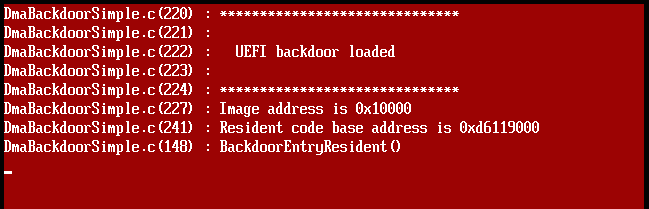
This repository contains a set of tools and proof of concepts related to PCI-E bus and DMA attacks. It includes HDL design which implements software controllable PCI-E gen 1.1 endpoint device for Xilinx SP605 Evaluation Kit with Spartan-6 FPGA. In comparison with popular USB3380EVB this design allows to operate with raw Transaction Level Packets (TLP) of PCI-E bus and perform full 64-bit memory read/write operations. It’s early version of my first much or less complicated FPGA project, so the speed is quite slow (around 1-2 Mb/s), but in upcoming releases it will be significantly increased by connecting PCI-E endpoint to MicroBlaze soft processor with AXI DMA engine. However, even such low speed is more than enough for reliable implementation of various practical attacks over PCI-E bus: to demonstrate applied use cases of the design, there’s a tool for pre-boot DMA attacks on UEFI based machines which allow executing arbitrary UEFI DXE drivers during platform init. Another example shows how to use pre-boot DMA attacks to inject Hyper-V VM exit handler backdoor into the virtualization-based security enabled Windows 10 Enterprise running on UEFI Secure Boot enabled platform. Provided Hyper-V backdoor PoC might be useful for reverse engineering and exploit development purposes, it provides an interface for inspecting of hypervisor state (VMCS, physical/virtual memory, registers, etc.) from guest partition and perform the guest to host VM escape attacks.

https://github.com/Cr4sh/s6_pcie_microblaze

kernelstub

Ian Santopietro of System76 has a Python-based tool called kernelstub, which boots Linux using the Linux Stub bootloader instead of an external bootloader.

Kernelstub is a basic program enabling booting from the kernel’s built-in EFI Stub bootloader. It keeps the ESP and NVRAM up to date automatically when the kernel updates and allows for modifying and setting the boot parameters/kernel options stored in NVRAM. Kernelstub is a basic program enabling booting from the kernel’s built-in EFI Stub bootloader. It keeps the ESP and NVRAM up to date automatically when the kernel updates and allows for modifying and setting the boot parameters/kernel options stored in NVRAM. It works by detecting certain information about the running OS, kernel, storage devices, and options, then combines all of that together into a unified entity, then calls efibootmgr to register the kernel with the NVRAM. It also copies the latest kernel, initrd.img to the EFI System Partition so that UEFI can find it. It will also store a copy of the kernel’s command line (/proc/cmdline) on the ESP in case of necessary recovery from an EFI shell.

https://launchpad.net/kernelstub

He just gave a talk/demo of it at SeaGL:

https://osem.seagl.org/conferences/seagl2017/program/proposals/326

His presentation mentioned this blog in the ‘more info’ slide! 🙂

Ekoparty presentation by Eclypsium available

Click to access us-17-Bazhaniuk-Bulygin-BluePill-for-Your-Phone.pdf


AMI announces full Redfish 1.0 support

American Megatrends Announces Full Support for Redfish™ 1.0 Specification in Aptio® V UEFI BIOS and MegaRAC® BMC Remote Management Firmware
Monday: October 2, 2017

AMI has announced its full support for the Redfish™ 1.0 specification from the Distributed Management Task Force (DMTF), in both its Aptio® V UEFI BIOS Firmware as well as several products within the MegaRAC® Manageability Framework – the most widely used solution in the market today. […] In addition to its industry-leading Aptio® V UEFI BIOS Firmware, known and trusted by Tier One OEMs and ODMs around the globe, products from AMI featuring support for Redfish 1.0 include the fully-integrated MegaRAC Pooled System Management Engine (PSME) firmware solutions, which enable efficient resource management for Network, Storage and Compute hardware throughout the data center, as well as MegaRAC Composer™ Pod Management Software.[…]

https://ami.com/en/products/remote-management/rack-scale-design-solutions/.

https://ami.com/en/news/press-releases/american-megatrends-announces-full-support-for-redfish-10-specification-in-aptio-v-uefi-bios-and-megarac-bmc-remote-management-firmware/

http://redfish.dmtf.org/