And newer Librems have TPMs bulit-in now.
https://puri.sm/posts/librem-now-most-secure-laptop-under-full-user-with-tamper-evident-features/
Hastily-written news/info on the firmware security/development communities, sorry for the typos.
And newer Librems have TPMs bulit-in now.
https://puri.sm/posts/librem-now-most-secure-laptop-under-full-user-with-tamper-evident-features/
https://twitter.com/qrs/status/948181434296164352
LinuxBoot at 34c3
This is an annotated transcript of an overview talk that I gave at 34C3 (Leipzig 2017) entitled “Bringing Linux back to the server BIOS with LinuxBoot”.
https://trmm.net/LinuxBoot_34c3
https://ami.com/en/tech-blog/intel-says-bye-to-bios-by-2020/
Click to access Brian_Richardson_Intel_Final.pdf
The UEFI Forum likes to frame UEFI -vs- BIOS, and has a 3-5 Class heirarchy of those systems, including having to deal with UEFI systems that also provide BIOS via Compatibility Support Module (CSM), referring to BIOS as Legacy Mode. If you look at BIOS outside of the framing of the UEFI Forum, it is usually based security, and UEFI has some security where BIOS has none. But there’s another ‘class’: non-UEFI coreboot, optionally secured with Verified Boot, with a BIOS payload. UEFI Forum doesn’t include this in their Class heirarchy… AFAICT, the mainstream IBVs have given up on BIOS and migrated to UEFI. The only places where BIOS will probably remain are in Purism boxes, where they will use TPM+Heads to secure BIOS, or on Chrome boxes, where they will use coreboot Verified Boot to secure BIOS, or in SeaBIOS-based VMs. When Intel stops offering Intel’s implementation of BIOS, maybe this means that the remaining BIOS users will switch to the open source SeaBIOS project, which is great news. Getting rid of the complex class of dual UEFI/BIOS systems will be a joy. 🙂
Re: https://firmwaresecurity.com/2017/11/15/purism-librem15-fails-chipsec-security-tests/
Purism responds to the CHIPSEC failures here:
https://forums.puri.sm/t/user-flashable-coreboot-vs-chipsec-security-test-cases/1918
They also point out in that forum, and here:
https://puri.sm/posts/tpm-addon-for-librem-laptops/
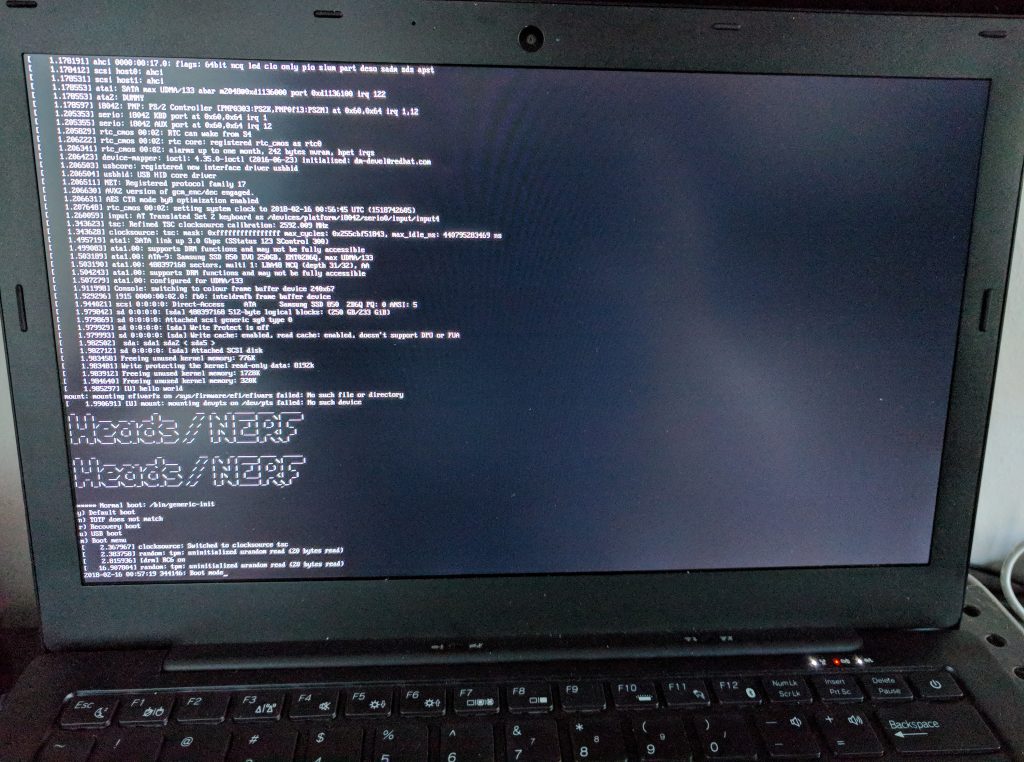
that Purism is getting ready to start using Heads payload. They’ve been talking about it for months, maybe it’ll be a real option for upcoming Librem customers? I’m very excited to see a Heads system available by an OEM, instead of DIY and not an easy task.
And they’re adding a TPM as an ‘add-on’ to existing Librem laptops. Heads needs TPM for it’s measurements. (Hmm, I thought TPMs were an integral and tamper-resistant part of the system, and something that could be added on for trust was called a smartcard, but ok. I guess you have to solder the HW to the system. I presume attackers will be ordering spare add-ons so they can swap out units.)
In the above Purism forum, there was this user comment:
“I like the idea of putting a demo Librem notebook to a BlackHat conf where they try to break into the devices. Would be a nice test and a good commercial for you.”
They cannot do that with current Librem models. 🙂 This will need to wait for TPMs to be pre-installed and Heads as the payload.
This response from the above Purism forum seems a bit invalid:
“So there’s no way to access a BIOS menu to change the boot sequence (boot from USB) or set a machine password etc?”
“No, there is no such thing. The BIOS boots into your machine in roughly 450 milliseconds, there is no support for a menu, there is no time even for the user to press a key on the keyboard to enter a menu. The idea of coreboot is to do the minimum hardware initialization and then go to a payload. In our case, we use SeaBIOS which itself will initialize the video card and show the splash screen logo, and wait for 2 seconds for you to press ESC to show you the boot menu and let you choose your device (otherwise, it just boots to the default one). The boot choice isn’t saved, it’s just a boot override. If you want to change an option in coreboot, you need to change the config in the source and recompile coreboot then reflash it. If you want to change the boot order, you need to change the boot order in a file embeded in the flash, then reflash the BIOS.”
Yes, there is thing, which the reply says does not exist then a few sentences later explains that it does exist. The BIOS menu to change the boot order is available to anyone with physical access to the system, and presses the ESC key within 2 seconds of poweron. The unprotected BIOS and MBR-based hard drive can be quickly overwritten with malware on the attacker’s boot thumbdrive. Attendees of ‘a BlackHat conf’ will have such skills. 🙂
Purism is spending all their time undoing Intel’s features — Intel ME, Intel FSP, and now re-embracing older features — Intel TPM. Intel SMM is still an issue, STM is not being used by Purism. Intel ME may be disabled, but it’s a black-box device, who knows when attackers will start reactivating it and putting their malware-based version of Minix on that chip? You’re going to need tools to detect if ME is really disabled. I hope Purism’s roadmap has a RISC-V chip-based laptop in it, so they can stop fighting Intel features and have a fully-open stack. If they keep fighting the Intel stack, I hope they add the ‘stateless laptop’ that Joanna has proposed to their roadmap:
https://blog.invisiblethings.org/2015/12/23/state_harmful.html
It might be useful to add coreboot Verified Boot to help secure their SeaBIOS payload, but that could probably only secure PureOS, and distro hoppers will have no benefit. But I don’t think Heads and Verified Boot are compatible? SeaBIOS also has TPM support, that’d be nice to see those measurements used, if they are embracing a TPM. And now that they have a TPM, they can start using Intel TXT too. 🙂
I am a little perplexed about Purims customer audience, who is concerned about privacy, and yet has so little concern for security, in exchange for the convenience feature of being easy to distro-hop. Anyway, if you want security, wait for the TPM and Heads to be integrated with future Librems.
https://trmm.net/Installing_Heads
It looks like Purism is going to use Heads now! I hope other OEMs consider some of the features Heads offers.
http://finance.yahoo.com/news/security-researcher-trammell-hudson-device-160000558.html
https://puri.sm/posts/purism-collaborates-with-heads-project-to-co-develop-security-focused-laptops/
I’ve made one brief post on Heads. Earlier I thought it was a new Linux distribution, which is not the case, it is more of a coreboot payload.
Heads looks great! I am currently looking for a used Thinkpad to test one out. I hope others add support for other systems.
If you have not watched the CCC video, check it out, it is very informative.
https://trmm.net/Installing_Heads
https://trmm.net/Category:Heads
The 33rd Chaos Communication Congress (CCC) takes place in December in Germany. There are MANY great presentations, and CCC is great at making video archives available. Here’s a sample of a few of the presentations, starting with Trammell’s lecture on Heads:
Bootstraping a slightly more secure laptop
Trammell Hudson
https://fahrplan.events.ccc.de/congress/2016/Fahrplan/events/8314.html
What could possibly go wrong with <insert x86 instruction here>?: Side effects include side-channel attacks and bypassing kernel ASLR
Clémentine Maurice and Moritz Lipp
https://fahrplan.events.ccc.de/congress/2016/Fahrplan/events/8044.html
Untrusting the CPU: A proposal for secure computing in an age where we cannot trust our CPUs anymore
jaseg
https://fahrplan.events.ccc.de/congress/2016/Fahrplan/events/8014.html
Virtual Secure Boot: Secure Boot support in qemu, kvm and ovmf
Gerd Hoffmann
https://fahrplan.events.ccc.de/congress/2016/Fahrplan/events/8142.html
Full schedule:
https://fahrplan.events.ccc.de/congress/2016/Fahrplan/schedule.html
https://events.ccc.de/congress/2016/wiki/Main_Page
https://twitter.com/fowlslegs/status/782711615816740864
Heads is a very interesting new distro by Trammel Hudson. If you like Qubes or Subgraph or Tails, read about this new distro.
The threat model that Heads proposes to address is very different from that of Tails. Tails’s goal is to allow users to to do computation on a machine in a way that doesn’t leave in trace on that system. This requires that the hardware in the system is trusted, which unfortunately is not the case for many users. Additionally many users need a way to keep state in a permanent way and don’t want to expose this state to random machines. Their machines might be subject to physical attacks that might install untrusted firmware or other devices into the system.[1][2] For these reasons, Tails is not sufficient for many users who want a laptop that they can travel with and want to have some assurances that most adversaries won’t be able to modify the hardware underneath them. Complicating this goal is that modern x86 hardware is full of modifiable state[3] and it is full of dusty corners that can hide malware or unauthorized code. Additionally there is unverifable code running in the Intel Management Engine, which has access to memory, to the network and various other peripherals. As a result we must trust certain entities more than others and this does affect our threat model. This document discusses some of the threats that make building slightly more secure mobile systems very difficult. There is a separate guide on installing Heads on the Thinkpad x230, which covers the practical issues of hardening a laptop against some of the threats described here. […]”
Hastily-written news/info on the firmware security/development communities, sorry for the typos.
Hastily-written news/info on the firmware security/development communities, sorry for the typos.
Hastily-written news/info on the firmware security/development communities, sorry for the typos.
Hastily-written news/info on the firmware security/development communities, sorry for the typos.
Hastily-written news/info on the firmware security/development communities, sorry for the typos.
Hastily-written news/info on the firmware security/development communities, sorry for the typos.
Hastily-written news/info on the firmware security/development communities, sorry for the typos.
Hastily-written news/info on the firmware security/development communities, sorry for the typos.
Hastily-written news/info on the firmware security/development communities, sorry for the typos.
Hastily-written news/info on the firmware security/development communities, sorry for the typos.
Hastily-written news/info on the firmware security/development communities, sorry for the typos.
Hastily-written news/info on the firmware security/development communities, sorry for the typos.
Hastily-written news/info on the firmware security/development communities, sorry for the typos.
Hastily-written news/info on the firmware security/development communities, sorry for the typos.
Hastily-written news/info on the firmware security/development communities, sorry for the typos.
Hastily-written news/info on the firmware security/development communities, sorry for the typos.
Hastily-written news/info on the firmware security/development communities, sorry for the typos.
Hastily-written news/info on the firmware security/development communities, sorry for the typos.
Discover the Desktop
Hastily-written news/info on the firmware security/development communities, sorry for the typos.
Hastily-written news/info on the firmware security/development communities, sorry for the typos.
Hastily-written news/info on the firmware security/development communities, sorry for the typos.
Hastily-written news/info on the firmware security/development communities, sorry for the typos.
Hastily-written news/info on the firmware security/development communities, sorry for the typos.
Hastily-written news/info on the firmware security/development communities, sorry for the typos.
Hastily-written news/info on the firmware security/development communities, sorry for the typos.
Hastily-written news/info on the firmware security/development communities, sorry for the typos.
Hastily-written news/info on the firmware security/development communities, sorry for the typos.
Hastily-written news/info on the firmware security/development communities, sorry for the typos.
Hastily-written news/info on the firmware security/development communities, sorry for the typos.
Hastily-written news/info on the firmware security/development communities, sorry for the typos.
Hastily-written news/info on the firmware security/development communities, sorry for the typos.
Hastily-written news/info on the firmware security/development communities, sorry for the typos.
Hastily-written news/info on the firmware security/development communities, sorry for the typos.
Hastily-written news/info on the firmware security/development communities, sorry for the typos.
Hastily-written news/info on the firmware security/development communities, sorry for the typos.
Hastily-written news/info on the firmware security/development communities, sorry for the typos.
News from coreboot world
Hastily-written news/info on the firmware security/development communities, sorry for the typos.
Hastily-written news/info on the firmware security/development communities, sorry for the typos.
Just another WordPress.com site
Hastily-written news/info on the firmware security/development communities, sorry for the typos.
 Firmware Security
You must be logged in to post a comment.